Roadmap theater: why a pretty Gantt chart hides a development team that does not deliver
The roadmap slide looks gorgeous: colorful bars, aligned milestones, everything "on track". But the product is not moving. Management theater is the art of looking like you ship without shipping. 6 signs you are paying for a show, not for software.
Por Victhor Araújo
Founder of Revin. Engineer by training, specialist in software development and digital products.
The monthly roadmap meeting is flawless. The project manager opens a Gantt chart with 14 colorful bars, milestones aligned on a perfect diagonal, a legend with green, yellow, and one discreet red that is "already being handled". The founder leaves reassured. Three months later, the feature promised for April still is not in production, and the next meeting roadmap is just as pretty — only with the dates pushed to the right.
This is management theater: the art of looking like you ship without shipping. The artifact (the slide) becomes the product, because the slide is what the client sees and praises. The actual software — which nobody in the meeting opens — gets pushed to later.
This article is for founders and CEOs who approve a beautiful roadmap but feel the product is not keeping up, and for CTOs who know the theater exists but cannot name it for the board.

The polished status meeting becomes the product: when the presentation consumes more energy than the delivery, you are paying for theater
🎭 1. The roadmap is gorgeous, but the demo is always "next week"
The number one sign of theater is the asymmetry between the presentation and the product actually running. The slide has the polish of an ad agency. The demo, when it happens, is in staging, with mocked data, or simply "let us leave it for next time".
A roadmap is a promise. A demo is the proof. When the promise is consistently more elaborate than the proof, you are funding a presentations team, not an engineering one.
Opaque squads present the plan. Senior squads present working software — every week, in a real environment, with the founder clicking.
📅 2. The dates slip, but the explanation is always new
April became May "because the context changed". May became June "because a new requirement came up". June becomes July "because of an external dependency". Each delay has a different, plausible justification that is impossible to challenge from the outside.
The pattern matters more than any single justification: if the date moves every month and the excuse never repeats, the problem is not the context — it is the absence of an honest estimation method.
Senior squads miss estimates too, but they show the miss in decision format: "we underestimated the payment module by 40%, here is what we learned and the new range with the uncertainty margin spelled out". Revin reports estimation drift openly every month — because hiding the drift is exactly what creates the theater.
📢 Suspect your roadmap has become theater? Book a Diagnostic Sprint — in 2 weeks we compare what was promised with what is actually in production.
🟡 3. Everything has been "80% done" for a month
The "last 20%" effect is the theater favorite stage. A feature sits at 80% for weeks because the easy 80% is done and the hard 20% — error handling, edge cases, real integration — has been pushed forward.
Self-reported completion percentage is the easiest metric to fake that exists. Nobody audits the "80%". It only turns into 100% when the client complains enough.
Opaque squads measure completion percentage. Senior squads measure what is in production and working — binary, with no gray zone of "almost there".
📊 4. Vanity metrics instead of delivery metrics
The report is full of numbers that go up: hours worked, commits, planned story points, tickets opened. They all grow. None of them answers the question the founder actually has: what is working in production that was not working last month?
Planned story points are not delivery. Commits are not value. Hours are not progress. They are inputs. Theater loves inputs because inputs always rise and never expose that the outcome has stalled.
Senior squads report lead time (idea to deploy), deployment frequency, and the concrete list of what shipped to production. Outcome metrics, not effort metrics.
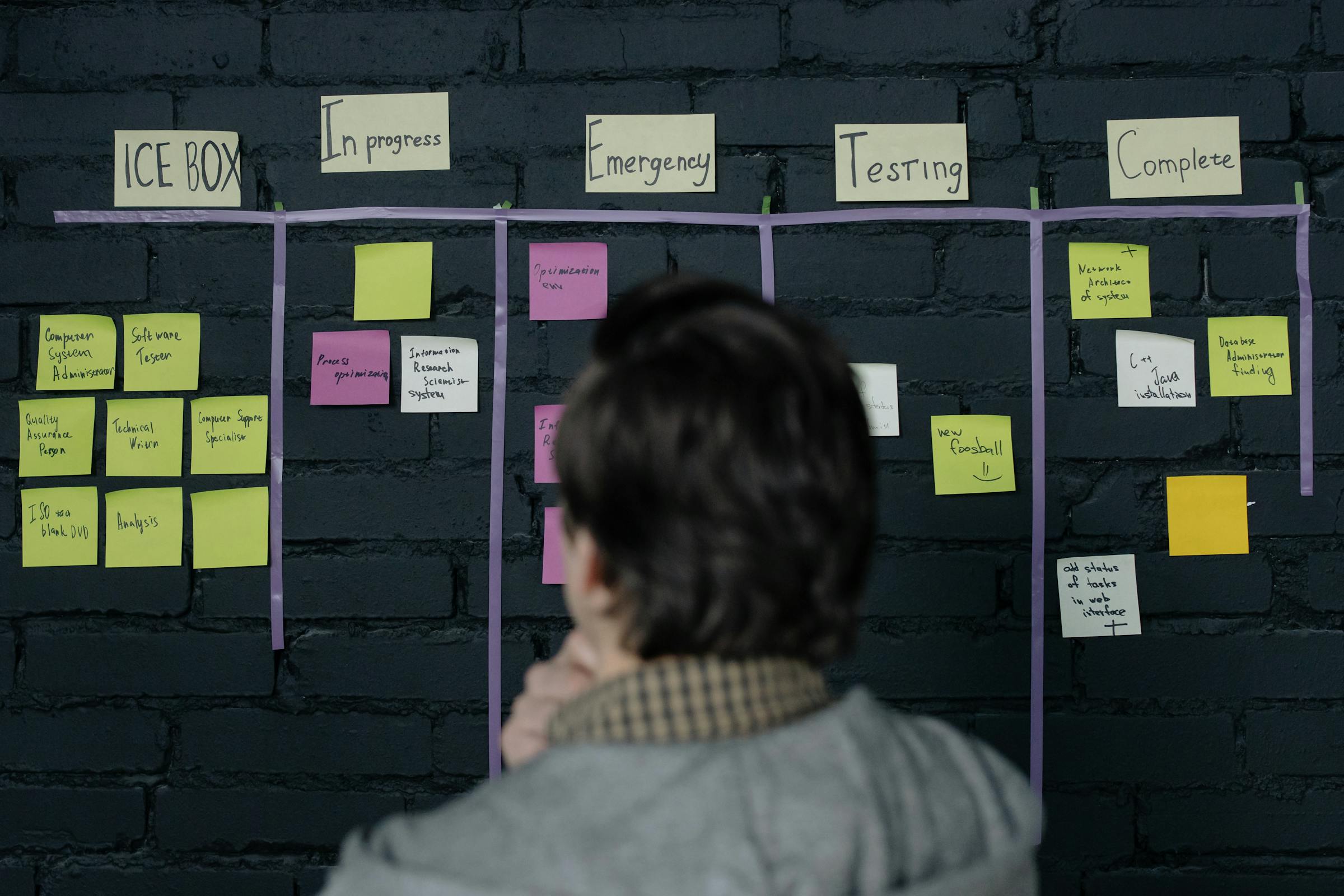
The real task board tells a different story than the slide hides: cards stuck for weeks in the same status
🗂️ 5. The real board contradicts the slide
Ask to open Jira or Linear live, with no preparation. If the real board matches the slide, great. If the board has 12 cards stuck in "in progress" for three weeks while the slide says "on track", you have just found the theater.
The slide is curated for the meeting. The board is what the team actually does. The distance between the two is the exact size of the performance.
Revin gives the founder direct access to the real board — not an intermediated slide. Radical transparency kills the theater because it removes the stage.
🧑💼 6. More people coordinating than building
Count the people in the status meeting. Now count how many write code. When the ratio of project managers, scrum masters, and "delivery leads" grows faster than the ratio of engineers, the theater has become structure.
Coordination layers exist to produce reports and meetings — exactly the artifacts of theater. Each layer adds a filter between the founder and the technical truth.
The senior managed-squad model flips this: a few seniors who build and report directly, with no political translation layer in between. Revin runs lean squads where the people who deliver are the people who talk to the founder.
📢 Want to see senior squads that report real delivery, no theater? Browse our cases — clients across Brazil, the US and the UK who traded the pretty slide for software in production.
🎯 Conclusion: demand proof, not promise
Roadmap theater survives because it is comfortable for both sides: the vendor shows a flawless slide and the founder feels in control. Both leave the meeting satisfied and the product stays put.
The cure is simple to state and uncomfortable to apply: stop accepting the slide as a deliverable. Demand running software, in production, every week. Demand outcome metrics, not effort metrics. Demand access to the real board. A squad that does theater will resist every one of these requests. A senior squad already works this way by default.
📢 Want a squad that shows running product instead of a pretty slide? Schedule a call — in 30 minutes we assess whether your current roadmap is delivery or performance.
6 read minutes
Article content:
Ready to elevate your business
Schedule a meeting



AI software development: review is the new bottleneck
Anthropic went from 2,500 to over 30,000 merges a day in four months. Three numbers from your own repo that show whether verification fell behind.
 Victhor Araújo
Inherited spaghetti code: the first 7 days, in order
Inherited spaghetti code from a vendor that left? The order of the first 7 days: what to measure before writing a line, what to freeze, and how it turns into three timelines.
Victhor Araújo
AI code review: how far you can take the human out
AI code review approves what a rule can verify. Anything that changes business behaviour still needs a person. Where to draw the line, and the month-14 bill.
Victhor Araújo
Technical debt from AI coding agents: how to measure the bill
Technical debt written by coding agents never shows up as a bug, it shows up as schedule. Three counts you can run this afternoon, plus what to change in code review.
Victhor Araújo